Wheezing after cigarette, bidi, hookah or vape exposure is not automatically an allergy, and smoking can change both symptoms and lung-function results. You will learn which tests to request, how to prepare, what makes a result trustworthy, and when a Pune clinician should investigate asthma, COPD or another cause.
Key takeaways
- Give your smoking timeline, including pack-years, bidis, hookah and vaping.
- Spirometry measures airflow before and after a bronchodilator.
- Avoid smoking before testing and follow inhaler instructions from the clinic.
- Persistent symptoms need assessment for COPD, infection and other lung conditions.
When wheezing in a smoker needs more than an allergy label
Do not report “I wheeze because of allergy.” Give the clinician a smoking timeline: cigarettes or bidis per day, years used, pack-years, hookah sessions, vaping products, when you last smoked, and exposure to household or workplace smoke. Include whether symptoms worsened after starting, stopping or increasing tobacco.
Describe the pattern, not just the sound. Tell the clinician:
- Whether wheeze, cough, chest tightness or breathlessness is episodic or present most days
- Whether symptoms wake you at night, follow exercise, cold air, dust, perfume or work exposure, or improve after an inhaler
- Whether you have daily phlegm, reduced exercise tolerance or gradually worsening breathlessness, which supports smoking-related COPD
- Whether fever, sudden deterioration, coloured sputum, chest pain or blood in sputum suggests infection or another urgent problem
- Whether breathlessness occurs lying flat, with ankle swelling or with chest pressure, which raises concern about heart disease
- Whether tightness is felt in the throat, with a noisy inward breath, voice change, abrupt exercise-related onset and rapid recovery; that pattern suggests inducible laryngeal obstruction
Smoking can worsen asthma control and blunt treatment response, so a normal test between attacks does not settle the diagnosis. An asthma allergy specialist in Pune or an allergy specialist for wheezing in Pune should review inhaler technique and arrange interpretable pulmonary-function testing when COPD, infection or heart disease remains possible.
Which lung-function tests answer the asthma question?
The expected first pulmonary function test is quality-controlled spirometry, followed by bronchodilator testing when airflow is reduced or asthma remains plausible. For smoking-related asthma, it measures how much air you exhale and how quickly, providing objective evidence to compare with your symptom pattern.
| Test | Main measurement | What it helps show |
|---|---|---|
| Spirometry | FEV1, FVC and FEV1/FVC ratio | Airflow obstruction and the amount of air exhaled |
| Bronchodilator testing | Change in FEV1 or FVC after inhaled medicine | Reversible narrowing that supports asthma |
| Peak-flow monitoring | Daily highest expiratory flow | Variation over days or weeks, which can support variable asthma |
| Lung-volume testing | TLC, RV and residual air after exhalation | Hyperinflation or air trapping, findings that raise concern for COPD |
| Diffusing-capacity testing | DLCO, the transfer of gas from air sacs into blood | Reduced gas transfer, which can point toward emphysema or another lung problem |
A normal spirometry result between attacks does not exclude asthma; repeated testing or peak-flow monitoring can capture variability. Persistent obstruction, hyperinflation or reduced DLCO makes uncomplicated asthma less likely and prompts assessment for smoking-related COPD or asthma-COPD overlap.
FeNO can support assessment of type-2 airway inflammation and corticosteroid responsiveness, but it is not a stand-alone asthma test. Smoking and inhaled corticosteroids can change its result, so interpret it alongside spirometry, exposure history and symptoms.
How to prepare for spirometry and produce a usable result
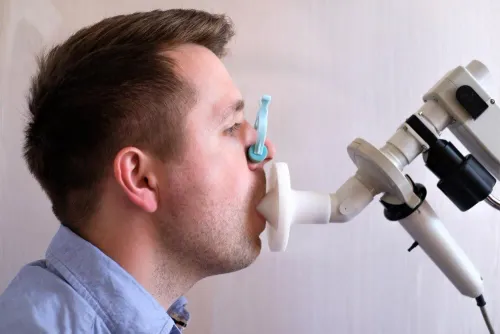
Spirometry records how much air you move and how quickly you move it. You will sit upright, wear a nose clip, inhale fully, seal your lips around the mouthpiece, then blast the air out rapidly and forcefully until your lungs are empty. You repeat the manoeuvre until the blows are acceptably consistent, often with coaching.
Before the appointment:
- Follow the clinic’s instructions about withholding inhalers; do not stop prescribed medicine without asking. Record the inhaler name and time of your last dose.
- Avoid smoking, vaping and strenuous exercise immediately before testing, and tell the technician when you last used tobacco.
- Wear loose clothing, avoid a large meal beforehand, and report chest pain, recent infection or an asthma flare before starting.
- Bring details of cigarettes, bidis, hookah, second-hand smoke and workplace exposure.
A usable report compares pre- and post-bronchodilator results and includes the reference equations, test date, acceptability and repeatability indicators. Ask an asthma breathing test clinic whether trained staff use calibrated equipment and whether a clinician reviews the complete report.
| Technical problem | What goes wrong | Effect on the report |
|---|---|---|
| Air leak around the mouthpiece | Escaped air lowers recorded volume | FVC may look falsely low |
| Cough during the first second | Interrupted force reduces FEV1 | Obstruction may appear worse |
| Slow start or weak blast | Exhalation is not truly forced | FEV1 becomes unreliable |
| Stopping too early | Air remains in the lungs | FVC is underestimated |
| Inconsistent repeated blows | Results differ widely | The test may need repeating |
How clinicians read pre- and post-bronchodilator results
The key distinction is whether airflow limitation is variable and reversible, or remains persistently restricted after bronchodilator use. Clinicians compare the complete, quality-checked spirometry report with predicted values, lower limits of normal and the test’s repeatability indicators.
| Measure | Pattern supporting asthma | Pattern supporting smoking-related COPD or overlap |
|---|---|---|
| FEV1 | Rises after bronchodilator or varies substantially between visits | Remains reduced, especially with persistent obstruction |
| FVC | May increase when narrowed airways open or trapped air is released | May stay reduced from hyperinflation or air trapping |
| FEV1/FVC | Low during symptoms but returns toward normal supports variable obstruction | A persistently low post-bronchodilator ratio supports COPD |
| Peak flow | Day-to-day or morning-evening variability supports asthma | A consistently low, less variable value supports fixed obstruction |
| Bronchodilator response | FEV1 or FVC rises by at least 12% and 200 mL in an adult | Little change does not exclude asthma, particularly after smoking-related airway damage |
A positive response supports asthma; it does not rule out COPD. Smoking can blunt treatment response, and asthma with fixed obstruction can resemble COPD, creating asthma-COPD overlap rather than a clean diagnosis.
Peak-flow readings become more useful when you record them twice daily for several weeks, alongside symptoms and inhaler use. A smoking asthma pulmonary function test may need lung volumes and diffusing capacity: hyperinflation and reduced diffusion capacity raise concern for emphysema.
An asthma allergy specialist in Pune should arrange respiratory review when obstruction persists or the results conflict with the history.
Choosing a Pune service and knowing when testing is not enough
A service should give you more than a label. Ask whether it records smoking or vaping exposure, performs calibrated spirometry, reports pre- and post-bronchodilator values, and has a clinician review the complete result.
If your search reads “asthma for allergy specialist smoking lung function test in Pune,” use these checks:
- Does the asthma breathing test clinic provide acceptability and repeatability indicators, reference equations, test date and raw values—not only “normal” or “abnormal”?
- Can it arrange lung volumes or diffusing capacity when obstruction persists, oxygen is low, or emphysema is suspected?
- Will someone assess inhaler technique and coordinate with a pulmonologist when the diagnosis remains uncertain?
At Dr Kunjir's Brio Clinic, ask who interprets the report and what happens if it suggests COPD, infection or another cause rather than uncomplicated asthma.
Routine care fits stable symptoms. Urgent assessment replaces an allergy specialist for wheezing in Pune when breathing is severe or rapidly worsening.
| Situation | What to do | Why it matters |
|---|---|---|
| Stable, familiar symptoms | Book routine testing | Testing can guide diagnosis and treatment |
| Persistent obstruction, frequent attacks, low oxygen, blood in sputum or abnormal imaging | Request prompt respiratory review | Pulmonary assessment may need more than allergy testing |
| Cannot speak comfortably, blue lips, confusion, chest pain, coughing blood or very low oxygen | Seek emergency care now | Lung-function testing must not delay treatment |
Frequently asked questions
What smoking information should you give an asthma allergy specialist?
Give your cigarettes or bidis per day, years used, pack-years, hookah sessions, vaping products, last smoking time and household or workplace smoke exposure. Mention changes after starting, stopping or increasing tobacco.
Which lung-function test helps assess asthma in a smoker?
Spirometry measures airflow before and after a bronchodilator. The clinician uses the results to assess obstruction and whether airflow improves after medication.
How should you prepare for spirometry?
Follow the clinic’s instructions about inhalers, avoid smoking before the test, wear comfortable clothing and avoid a large meal immediately beforehand. Bring your medication list and previous reports.
Why might spirometry not be enough for a smoker with wheezing?
Wheezing can also reflect COPD, respiratory infection, vocal-cord problems, heart disease or another lung condition. Persistent, severe or unexplained symptoms need further clinical assessment.
Keywords