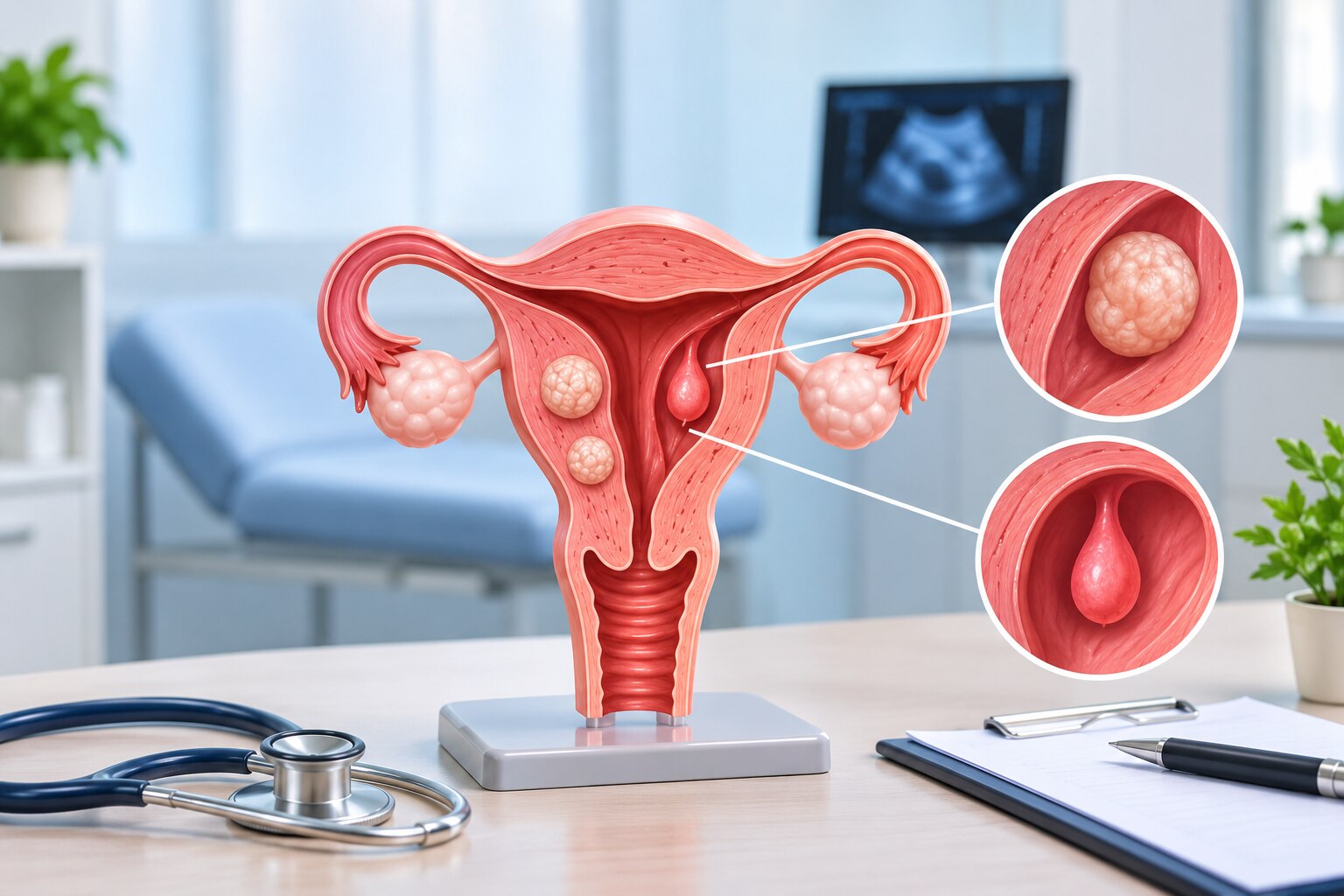
A fibroid or uterine polyp found during infertility testing is not automatically the reason for delayed conception, and removing it is not automatically the best next step. By the end, you will know which findings can affect implantation and pregnancy, which tests clarify their significance, and when treatment should come before natural conception, ovulation induction, IUI or IVF.
Key takeaways
- Cavity-distorting fibroids deserve fertility-focused assessment.
- Ask whether a polyp is inside the endometrial cavity.
- Removal before treatment depends on size, location and symptoms.
- Match uterine treatment with your ovulation, sperm and embryo plan.
When a Fibroid or Polyp Can Affect Fertility
A scan finding matters only when it changes the uterine environment or signals another problem. A submucosal fibroid, which grows into the endometrial cavity, can disrupt sperm movement, implantation and early placental development. Cavity distortion is also linked with miscarriage and poorer pregnancy outcomes.
ASRM reports fair evidence that removing a cavity-distorting submucosal fibroid improves clinical pregnancy rates, but evidence for improved live-birth rates remains insufficient.
The fibroid features that change fertility concern are:
- Submucosal, intramural or subserosal location
- Size and number of fibroids
- Distortion of the endometrial cavity
- Position near a fallopian-tube opening
- Heavy bleeding, pain, rapid growth or pressure symptoms
A polyp can create a local inflammatory environment that interferes with implantation and can cause irregular bleeding. In one IUI trial, hysteroscopic polyp removal was followed by a 28.3% clinical pregnancy rate, compared with 15.8% when the polyp remained; those results apply to that study population, not every patient.
A small, symptom-free polyp or a fibroid that does not distort the cavity is often an incidental finding. It may not prevent conception or require fertility-directed treatment. Before blaming the lesion, assess ovulation, ovarian reserve when indicated, semen, tubal patency, age and time trying.
Choosing fibroid polyp care for infertility patients in Pune should therefore include documented cavity assessment, not treatment based on an ultrasound label alone.
Which Findings Need Closer Investigation
A suspected lesion needs closer investigation when its position or attachment to the uterine cavity is unclear. Transvaginal ultrasound is usually the starting test, but saline-infusion sonography outlines the cavity more sharply; hysteroscopy provides direct viewing and allows removal or biopsy. Hysterosalpingography mainly checks whether the fallopian tubes are open.
| Finding | What helps distinguish it | Why it matters in infertility evaluation |
|---|---|---|
| Polyp | Focal tissue projecting into the cavity; hysteroscopy confirms its surface and attachment | A polyp is not proof of infertility, but bleeding, a larger lesion or repeated finding warrants review |
| Submucosal fibroid | Firm, rounded mass arising from the uterine muscle and pushing into the cavity | Document whether it distorts the cavity, including its size and percentage within the cavity |
| Adenomyosis | Thickened, uneven uterine muscle, small cysts or a bulky uterus on ultrasound or MRI | It involves the uterine wall rather than a discrete cavity mass |
| Thickened endometrium | Diffuse lining thickening measured against the menstrual-cycle phase | Persistent thickening or abnormal bleeding may require endometrial sampling |
| Endometrial clot | Irregular material that shifts, changes or disappears on repeat imaging | A clot lacks a fixed attachment; persistent tissue needs hysteroscopy or pathology |
The report should state whether the cavity is distorted, whether the lesion is near a fallopian-tube opening, and whether one or several lesions exist. A complete fibroids, polyps and infertility evaluation in Pune should also consider ovulation, ovarian reserve when indicated, semen analysis, tubal patency and age rather than treating an ultrasound finding in isolation.
Deciding Whether Removal Should Come First
Removal usually comes first when a confirmed polyp or submucosal fibroid projects into the uterine cavity, changes its shape, or causes recurrent bleeding. These findings can interfere with implantation, so treating them before trying naturally, ovulation induction, IUI or embryo transfer often makes the plan clearer.
- Remove a cavity-distorting lesion before fertility treatment when hysteroscopy or imaging confirms it, especially after repeated implantation failure, miscarriage or unexplained bleeding.
- Before trying naturally or using ovulation induction, discuss removal of a polyp that is persistent, symptomatic or clearly occupies the cavity. A small, uncertain finding may instead be rechecked or confirmed before surgery.
- Before IUI or IVF, remove a submucosal fibroid or significant polyp that could obstruct sperm transport or embryo implantation. Hysteroscopic removal lets the surgeon see the lesion rather than scraping blindly.
- Proceed without removal when a fibroid is subserosal or intramural, does not distort the cavity and has no concerning symptoms. Routine removal of every non-distorting intramural fibroid lacks strong fertility evidence and can add bleeding, adhesions and recovery time.
- Do not delay treatment for a normal cavity solely to perform hysteroscopy. In the TROPHY trial, outpatient hysteroscopy before IVF produced live birth in 29.8% versus 29.6% without it.
A uterine polyp fertility doctor in Pune should relate the decision to age, ovarian reserve when indicated, ovulation, semen analysis, tubal patency and time trying. Removing one lesion will not correct another infertility factor.
Comparing Hysteroscopy, Myomectomy and Other Options
A cavity-distorting polyp or submucosal fibroid gives removal the clearest fertility rationale. Hysteroscopy allows the surgeon to see the lesion, remove it precisely and confirm the cavity is clear; it is more targeted than blind dilation and curettage.
| Option | Fertility benefit | Limits and risks |
|---|---|---|
| Hysteroscopic polypectomy or myomectomy | Restores cavity shape and treats a lesion that could hinder implantation | Does not treat deep intramural or subserosal fibroids; risks include bleeding, uterine perforation, infection, incomplete removal and intrauterine adhesions |
| Laparoscopic or open myomectomy | Removes selected intramural or subserosal fibroids causing symptoms or cavity distortion | Surgery can cause bleeding, adhesions and uterine scarring; future delivery planning may change. Removing a non-distorting intramural fibroid has no strong fertility evidence |
| Medication | GnRH agonists can shrink fibroids and control bleeding before surgery | This is a short-term bridge, not definitive fertility treatment; fibroids often regrow after stopping, and medication does not remove a polyp or cavity lesion |
| Uterine-artery embolization | Shrinks fibroids without myomectomy and can reduce bleeding | Pregnancy is possible, but fertility and pregnancy-outcome evidence is less reassuring than after appropriately selected myomectomy; discuss ovarian, placental and pregnancy concerns before choosing it |
If you are comparing fibroid fertility treatment in Pune, ask which option matches the lesion’s location and your pregnancy timeline. Avoid treatment based on a scan finding alone.
Building a Fertility Plan Around the Uterine Finding
Do not let the ultrasound finding become the whole infertility plan. Ask the clinician to map the lesion’s size, number, location and effect on the uterine cavity, then compare that result with your age, time trying and previous pregnancy history. Removing a lesion will not correct an ovulation, sperm or tubal problem.
Ask these questions:
- Is the cavity distorted, and do we need saline sonography, 3D transvaginal ultrasound or hysteroscopy before choosing treatment?
- Should treatment happen before timed intercourse, ovulation induction, IUI or IVF, and how will recovery change the schedule?
- Do my cycles show ovulation, or do I need cycle monitoring or a progesterone test?
- Does ovarian-reserve testing with AMH, antral follicle count or other tests change the urgency or treatment sequence?
- Has my partner had a semen analysis, including repeat testing if the result is abnormal?
- Do I need tubal-patency testing with HSG or HyCoSy before proceeding?
- How do my age, duration of trying, prior pregnancy, miscarriage or ectopic pregnancy change the plan?
For fibroid polyp care for infertility patients in Pune, insist on a written sequence rather than treating the scan in isolation. A fibroids polyps infertility evaluation in Pune should also explain the evidence, operative risks and alternatives.
At Dr Kunjir's Brio Clinic, ask who will coordinate these findings if surgery, ovulation treatment or assisted reproduction involves different clinicians.
Frequently asked questions
When can a fibroid or polyp affect fertility?
A submucosal fibroid or an endometrial polyp can distort the uterine cavity, interfere with implantation and affect early pregnancy development.
Which fibroid or polyp findings need closer investigation?
Investigate findings that enter or distort the endometrial cavity, cause abnormal bleeding, recur, or appear alongside repeated miscarriage or failed fertility treatment.
Should fibroid or polyp removal come before fertility treatment?
Removal may come first when the lesion distorts the cavity, causes significant bleeding, or creates a clear barrier to implantation. The decision depends on its location, size and your fertility plan.
How do hysteroscopy and myomectomy differ?
Hysteroscopy treats lesions inside the uterine cavity through the vagina and cervix. Myomectomy removes fibroids from the uterus, using a hysteroscopic, laparoscopic or open approach based on size and location.
Keywords